
Research
From bones to genomes
Ancient genomics and forensic genetics bring complementary perspectives to the study of the human past.
01 / Archaeogenetics
Archaeogenetics
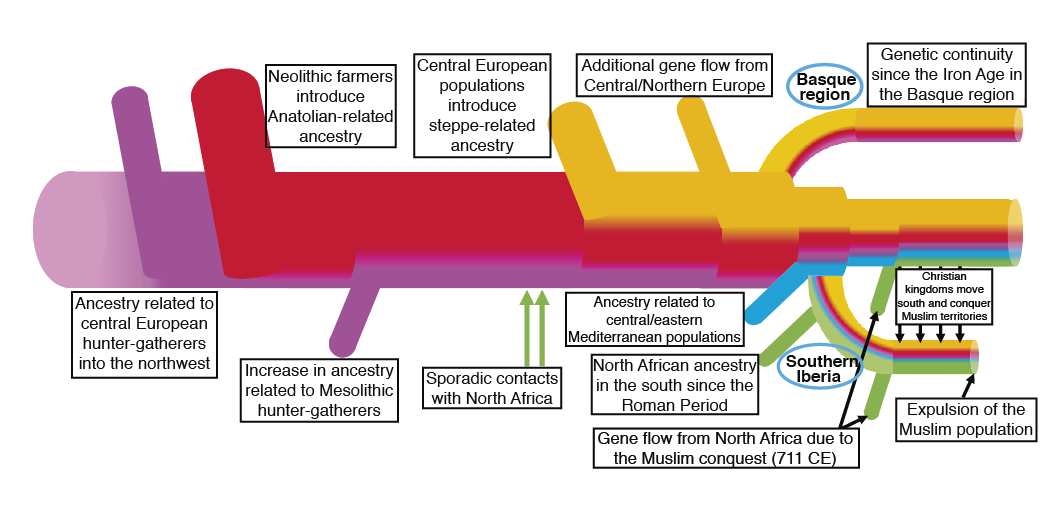
We establish close collaborations with archaeologists, anthropologists and historians to study human remains excavated at archaeological sites, with special focus on Western Europe over the past 10,000 years. Using Next-Generation Sequencing techniques (NGS), we generate genome-wide data from these skeletal remains and analyze this information using High-Performance Computing (HPC) and bioinformatic tools.
Our work integrates genomic data with other biomolecular methods and the archaeological context to study several questions about of the human past, such as how populations moved around and admixed with others they encountered, how social organization shaped human communities, how genetic variants with functional importance evolved over time, and how past epidemics impacted human societies.
We have an ongoing close collaboration with the laboratory of Dr. David Reich at Harvard University, pioneer in the application of NSG techniques to the study of human history.
Population history and mobility
Investigating how populations formed, moved and interacted over time through the genetic evidence preserved in archaeological remains.
Kinship and social organisation
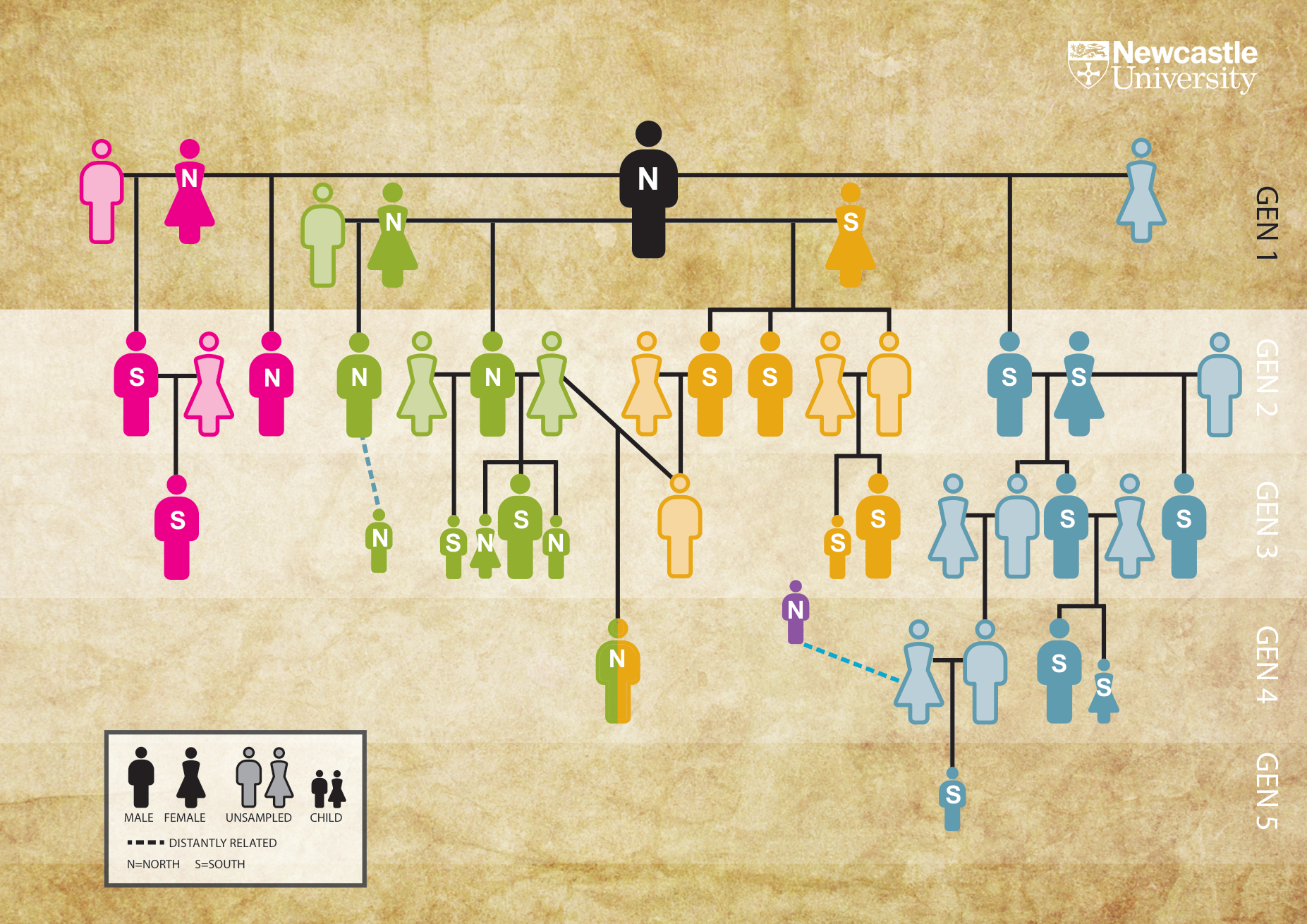
Exploring biological relationships alongside burial practices and archaeological context to reconstruct family pedigrees. We aim to understand how communities were structured, how identities and social positions were transmitted and the role that family relationships played in funerary practices and residential patterns.
Natural selection
Ancient genomes can provide unprecedented insights into the temporal allelic trajectory of important mutations, allowing us to understand their origin and the evolutionary forces behind their selective advantage.
Disease
Ancient pathogen DNA can be recovered from human remains and, in some cases, the complete genome of microorganisms responsible for infectious diseases can be reconstructed. This information provides a complementary perspective on episodes of mortality, demographic change, human mobility, and potential health crises.
02 / Forensic genetics
& historical memory
Forensic genetics
& historical memory
We apply forensic genetics to the identification of victims of the Spanish Civil War, contributing to processes of exhumation, identification and restitution.
Genetic identification
Over the past 15 years, our lab has intensively worked in the identification of Spanish Civil War remains from the victims buried in mass graves, together with Gogora (The Institute for Remembrance, Coexistence and Human Rights from the Basque Government), Sociedad de Ciencias Aranzadi and other association for the recovery of historical memory. To date, we have carried out the genetic analysis of more than 1000 human skeletal remains from the Spanish Civil War and posterior dictatorship, recovered from graves from different autonomous communities within Spain.
Families and memory
We have achieved a significant success in DNA profiling, with more than 300 skeletal remains identified and returned to the respective families. However, a large number of remains are still unidentified, despite having an informative genetic profile to be compared with reference samples. This is mainly due to the lack of appropriate family members for genetic comparisons, given the long time elapsed since the end of the conflict and the difficulty to find close relatives such as sons/daughters.
Further efforts are needed in order to get a major contribution of donors along the territory. Moreover, a stronger collaboration between national laboratories working in the identification processes would be advantageous for increasing the number of identifications.
Contact the group